
Findavia
One service marketplace for finding a provider, booking real availability, and coordinating the work.
Primary product engineer
View case study : FindaviaAI-native
I design and build intelligent products, agentic systems, and software architectures — combining engineering, product thinking, automation, and human-centered design.
Engineering depth.
A human perspective.
The problem, the architecture, and the decisions behind the build.
One service marketplace for finding a provider, booking real availability, and coordinating the work.
Primary product engineer
View case study : Findavia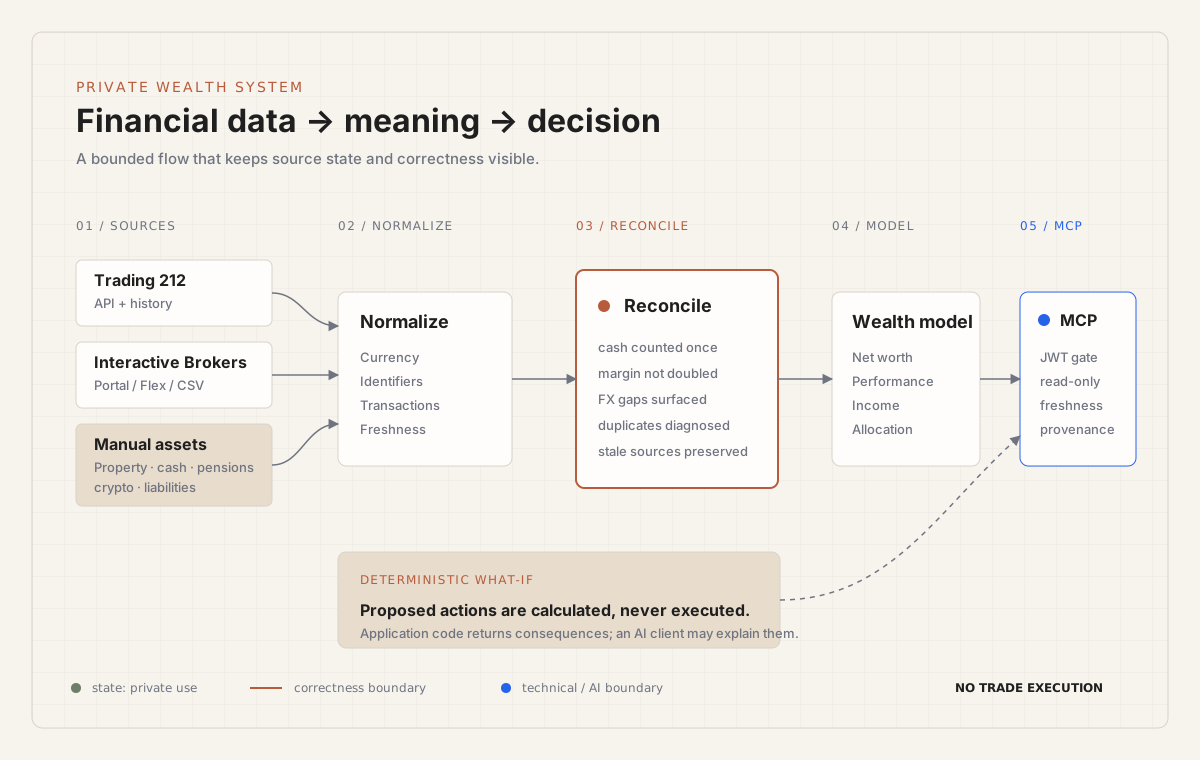
A private wealth operating system that reconciles brokerage data, manual assets, and deterministic scenarios behind a bounded AI interface.
Product & systems engineering
View case study : TreasuryAI expands what I can implement. The decisions and the checks still matter.
Start with the problem, the people, and the constraints.
Make product decisions and system boundaries explicit.
Use AI for implementation leverage, not as a substitute for judgment.
Test behavior, failure paths, and the assumptions that matter.
Use evidence to decide what needs to change.
Not a one-way handoff. Each validation step can send the work back to an earlier decision.
A little context
My background is in firmware and software engineering. I approach products as systems: the technical architecture, the workflow, and the people using it need to work together.
More about meBugs worth remembering, architecture choices that took some thought, and experiments that changed how I work.
A small check I use when a fix and its regression test are created together, especially in AI-assisted work.
How I split financial calculation, data quality, authorization, and AI interpretation inside Treasury.
A Findavia booking inconsistency pushed me to trace important workflows from the interface all the way to database enforcement and account authority.
Product / Systems / People